


Ereks Explains its Vertical Move & Circular Vision
Turkish denim manufacturing group Ereks Garment and Era Denim has a long reputation for sustainability, but now it is also targeting circularity.
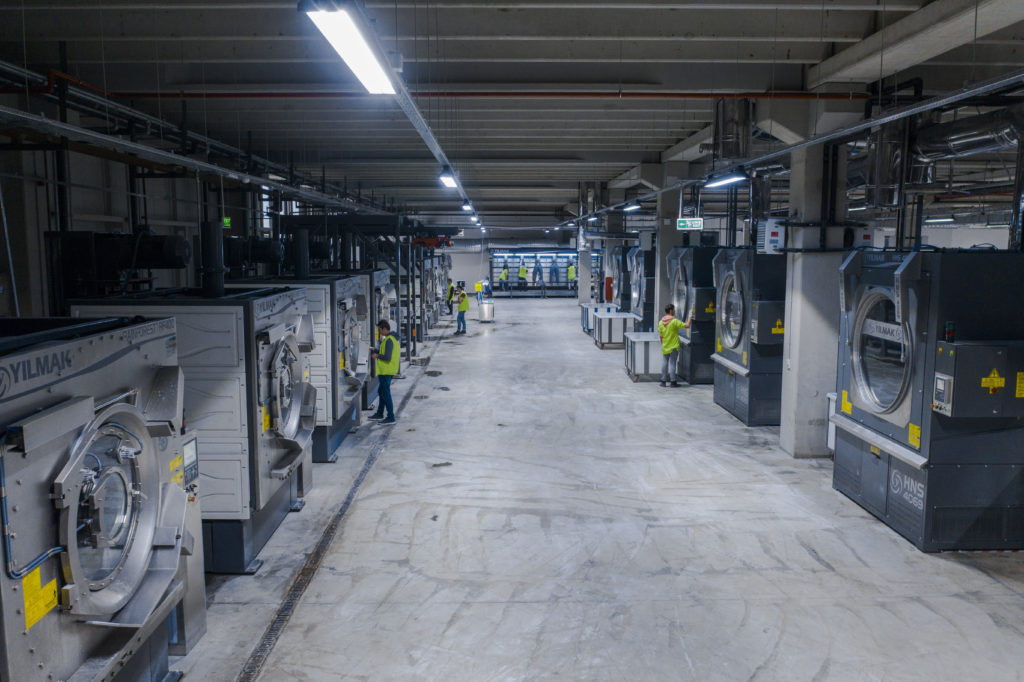
In 2020, Ereks introduced a strategy to be circular by 2030. Supporting this mission are the firm’s eco-friendly Blue Matters facilities. A plant in Esenyurt-Istanbul does cutting, sewing and finishing, while a second facility in Corlu-Thrace focuses on washing, sewing and finishing. The Corlu site was constructed out of sustainable materials, with features designed to lower the impact of producing denim. For instance, rainwater is collected from the rooftop to be used in manufacturing.
Ereks’ business development and circularity manager Kaan Sen spoke to Carved in Blue about the company’s sustainability work and why the industry should be less guarded about collaboration.
Carved in Blue: Can you tell us about your company?
Kaan: Ereks-Blue Matters has 35 years of manufacturing experience in the sector, but washing and finishing operations were conducted outside until 2019. We are grateful to all of our partners who were on the road with us so far, but we felt like we needed to change the way that we do our business towards another direction. Because you are not in complete control if you are not the one who is driving the car. We wanted to drive our own car and we wanted to do it differently. We have created the Blue Matters Responsible Production Platform by implementing responsible practices for the denim supply chain through our design-cutting-sewing-washing units with a digitalization vision, which allows us to monitor materials, impacts and outcomes more efficiently. We are committed to build a circular system to create a future without waste in every operation possible. That was the idea behind this factory.

Carved in Blue: Who are some of your customers? To what regions do you ship garments?
Kaan: The majority of our customers are from Europe and the United Kingdom. Some of our partners are Bestseller Group/Selected Femme, Superdry, Kings of Indigo, Mos Mosh, Fiorucci, and we are also working with Colin’s and Lee Wrangler in Turkey.
Carved in Blue: What are your sustainability initiatives?
Kaan: Sustainability has many definitions, but for us, it means consuming nature’s resources consciously without stealing from the next generations and preventing climate change with adapting circular strategies in every possible operation. We are working on different projects under three main headlines: sustainability, circularity and digitalization. In the sustainability part, we are working on projects such as a wastewater recycling system, solar panels, LCA (life-cycle assessment) analysis, corporate carbon emission score and ultimately to have our GRI sustainability reporting system. In circularity, we are a member of Jeans Redesign, Amsterdam Denim Deal projects, and we are one of the signatories of World Circular Textiles Day. Currently, we are building our regenerative circular garden next to our factory, where we work on soil recovery and biodiversity to have better carbon capture potential. We have also made an NDA agreement with a Dutch company and are working on an innovative project that focuses on the sorting and recycling of used clothes.
For digitalization, we have made an agreement with an ERP (enterprise resource planning) company so that we will monitor all inputs from raw materials till the end. We also established our digital showroom this year so that our customers can easily explore our collections via high-quality images. All in all, all of our projects serve the same goal, which is stopping the climate crisis and achieving circular production.
Carved in Blue: How did Covid affect your way of product development for customers?
Kaan: Covid-19 taught us different things—not just as a professional company, but also as a humankind. We understood that we are so vulnerable against nature and we really had time to think about our negative effects as an industry. It is quite clear that the pandemic is reshaping the fashion industry and consumer behaviors as well. Research shows that consumers will shop less and be choosier when they do, sales through social media and digital tools will increase, consumers will expect more, and eventually demand will increase for sustainability and purposeful brands. So, it is obvious that all the players in the supply chain must be prepared for fashion’s new reality.
As a manufacturer, we are quite ready because our vision has been built on this urgent idea; it wasn’t modified or adjusted according to any rules. I said it’s urgent because we do not have any time to spend with the traditional make-use-waste model. We define Blue Matters’ vision in that direction. We are putting a lot of efforts on digitalization, traceability and transparency because we know that consumer would like to know where their clothes are made. We are 100 percent ready for this!
Carved in Blue: How are you trying to reach brands with tradeshows cancelled, travel bans, and customers not working in the office?
Kaan: Although we miss traveling, face-to-face meetings and tradeshows a lot, it is inevitable that the way we do our business will not be the same as before the pandemic. Zoom meetings, digital fairs and many more ideas have jumped into our lives already. We have implemented Aver SVC/EVC series conferencing systems in all of our three locations in order to have better quality and unified video communication. We are able to make web-based real-time communication (WebRTC), dual-camera presentation and live video streaming that we can use to present our collections, ideas and our vision with our valuable customers. We also have created a digital showroom where our customers can explore different collections, washes and concepts with their buying team and make decisions.
Carved in Blue: Why do you like working with fabrics using TENCEL™?
Kaan: Working with TENCEL™ lyocell and TENCEL™ x REFIBRA™ technology matches 100 percent with our circularity vision and our ultimate goals. We need to be cautious about the resources that we consume and we need to design garments that are durable, degradable and easily recyclable. For this, we need to be selective on the fibers. It is crucial to minimize usage of virgin resources and man-made fibers such as polyester, polyamide and nylon.
We have worked with TENCEL™ Lyocell and REFIBRA™ technology fabrics in our special collection with Bossa. From fiber to washed garments, we minimized our impact on earth by Lenzing’s TENCEL™ x REFIBRA™ Lyocell fiber, Bossa’s sustainable indigo dyeing methods and our conscious washing operations. In addition, TENCEL™ Denim offers very good performance with ozone washes, TENCEL™ branded cellulosic fibers mixed with cotton in fabrics are not affected as much as pure cotton cellulose-based fabrics by the ozone treatment. The overall mechanical performance becomes better.
Carved in Blue: How is the current textile market situation in Turkey?
Kaan: I can say that Turkey was, is and is going to be an important player for the European market. Europe has declared a Green Deal agreement, and they want to be carbon neutral before 2050. The textile sector is responsible for 6 percent of the global greenhouse gas (GHG) emissions, and if you consider the current business models it will keep increasing in the coming years. Nearshoring is a hot topic nowadays, and we already experienced that some brands have started to come closer from Asia to Turkey and North Africa for narrowing their supply chain. Turkey will have an even stronger role to play in the denim world thanks to its vertically integrated denim sector from cotton fields to fabrics, making and trims. This gives the Turkish denim sector the possibility to be transparent, traceable, sustainable and produce in a fast and responsible way.
If we really want to reduce our emission as a fashion industry, we need to stop and think. Each brand or manufacturer should start to map their operations and see their GHG emissions. After that, we all need to look for ways to reduce them with proper strategies. Our time is limited, and we need to act immediately as an industry.
Carved in Blue: What do you think the denim industry is missing today?
Kaan: I think that we need to collaborate more throughout the denim supply chain. Companies need to be more transparent more collaborative with each other. I observe that most of the companies in Asia, North Africa and even in Turkey do not want to open their facilities because they’re afraid that their technology, washes, etc. might be copied by others. As I always state that we are not building spaceships. We are manufacturing jeans, and as an industry we need to be working together to spread ideas, to make improvements and ultimately to leave a better planet.
Carved in Blue: Are there influencers in the denim industry that inspire you?
Kaan: Yes, of course! I love the vision of Stella McCartney because her commitment to sustainability is evident throughout all her collections and is part of the brand’s ethos to being a responsible, honest and modern company. I believe people like Stella influence a lot of people for conscious design and production. I am also deeply influenced by the sustainable denim brands such as Kings of Indigo and Mud Jeans. Kings of Indigo focuses on organic, recyclable and low-impact washes. Mud Jeans also has strong vision on circularity; they are one of the first companies who lease jeans, and it is really innovative. We are quite happy with working and collaborating with such conscious brands.
Carved in Blue: What is your favorite city?
Kaan: I have been more than 35 countries so far and I love Barcelona! I can honestly say that Barcelona is a city where you can find many cultures and ideas living in harmony. The city is very much alive from streets to the buildings, and it always make me feel happy to see that people living in Barcelona make it Barcelona, not for any other reason.
Carved in Blue: What does Carved in Blue mean to you?
Kaan: Carved in Blue brings denim players together, and it is really important for the industry. I love to follow Carved in Blue to stay current on all the denim industry updates.