


Blue Cast: Sortile Co-founder Constanza Gomez on Solving Textile Sorting
One of the biggest challenges in circularity is identifying a garment’s fiber composition to determine how it should be processed. Typically, this is done by hand, with sorters reading tags, which can lead to human error. Adding to the issue? The fact that 30 percent of clothing is missing tags.
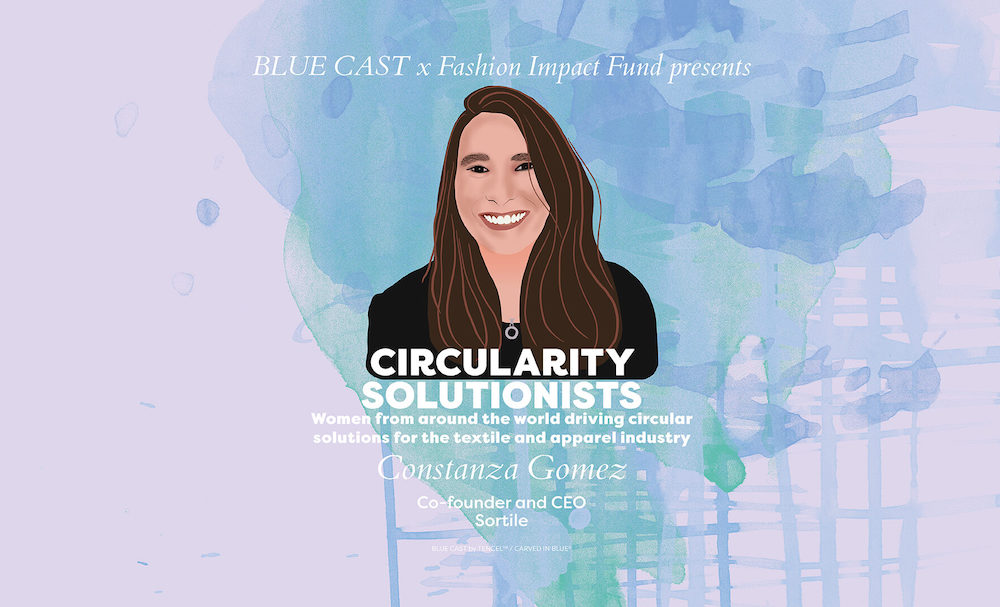
Sortile is on a mission to simplify this process through technology. For the second episode of Blue Cast’s four-part Circularity Solutionist series in partnership with the Fashion Impact Fund, Lenzing’s Tricia Carey spoke with Constanza Gomez, Sortile’s co-founder and CEO. The startup uses machine learning and algorithms to determine the material makeup of garments, helping to reduce errors and costs.
“We kept hearing, ‘Fiber-to-fiber recycling is the future.’ But so much of the core infrastructure that would feed into fiber-to-fiber recycling had not been developed,” said Constanza.
The first step in sortation centers is typically grading, during which workers determine whether garments are good enough quality to reuse. For items that would otherwise be discarded, Sortile can be used to give them a new life. Workers can scan apparel to get insight into material composition, allowing the clothing to go to recycling.
Constanza believes the industry has to get over its mentality that recycled materials should come cheap. Although the inputs are typically donated, a lot goes into turning these feedstocks into usable materials. “People don’t understand that there’s so much work that needs to be done from even getting these materials to actually being able to produce something and put it back into the circular economy,” she said.
To ramp up fiber-to-fiber recycling, one of the requirements is growing the volume of available materials for recyclers. Clothing collection rates in the United States have been stagnant at 15 percent for more than a decade, in part because it’s not worthwhile economically. “Collectors and sorters today do not have an incentive to sell to fiber-to-fiber recyclers, because manually sorting is just too expensive, it does not make economic sense,” Constanza noted. By simplifying the sorting process, Sortile aims to “change those incentives” and make it more financially viable.
Constanza sees the potential for recycled fiber use to scale, in part because of what is happening in policy and the industry. “It seems like those puzzle pieces that we’ve been trying to fit for so long are actually starting to kind of fit together,” she said. Eventually, she foresees circularity changing how apparel is created, bringing about the end of “five-way blends.”
Both Constanza and her co-founder Agustina Mir are moms, which she said makes them more cognizant of the future they are leaving. In her personal life, Constanza is devoted to circularity and buys vintage or secondhand clothes rather than new fashion.
“We deeply care about what’s happening to this world and what are we going to do for our kids and the next generation,” she said. “That in itself gives us that perspective of wanting to do something that will have a positive impact.”
Listen to the episode here.