


Lenzing Aims to ‘Activate Transformation’ with Latest Sustainability Report
Austria’s Lenzing Group wants to transform the textile industry through lower impact production methods, greener energy and caring for people and the planet. But it can’t do it alone.
The company’s 2024 Sustainability Report is titled “Activate Transformation Here,” acting as a call to action for the industry to join Lenzing and work with it to overcome challenges and accomplish change. Included in the report are stories of collaboration—from glacier protection to leather alternatives.
“To preserve our livelihoods and those of future generations, the global textile and nonwoven industry must transition to sustainable production. Although the necessary technologies and capacities are gradually coming to market, little progress has been made on a global scale so far,” said Rohit Aggarwal, CEO of the Lenzing Group. “At Lenzing, we have the know-how to produce fibers on a large scale from renewable raw materials and to recycle them sustainably. To make a difference, we need to move towards industry-wide collaboration with binding standards. This is certainly a challenge, but also an opportunity.”
Carbon
When compared to 2017 figures, Lenzing has reduced its specific greenhouse gas emissions by 41 percent. The company is working toward further significant reductions in emissions by 2030 across Scopes 1, 2 and 3 and net-zero emissions by 2050. Lenzing was one of the first in the industry to validate its net-zero target with the Science Based Targets initiative, and it received validation from SBTi for its updated climate targets adjusted in 2024 to match the Paris Agreement.
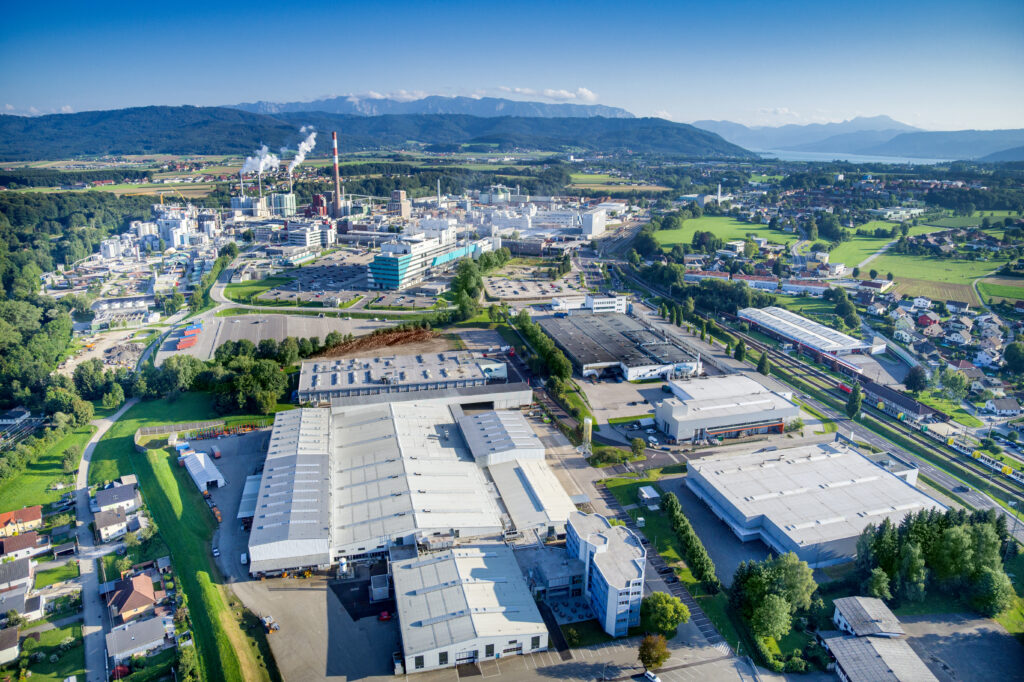
Toward this goal, Lenzing has been shifting away from fossil fuels. It installed a natural gas power plant at its production site in Nanjing, China. And in Austria, it is using a photovoltaic system and a biomass power plant. Additionally, it invested 200 million euros in modernizing its China and Indonesia production sites.
Water
Water stewardship is another major pillar in Lenzing’s action plans. Lenzing’s plant in Grimsby in the United Kingdom finished building phase one of its upgraded wastewater treatment plant, which is projected to reduce wastewater emissions by 80 percent once completed and operational.
Innovation
Lenzing is also using its textiles to improve the environment beyond its own operations. Last year, the group launched a project that used its wood-based fibers to create geotextiles to cover glaciers, protecting the ice caps. Typically, these geotextiles would be made with synthetics, which release plastic microfibers into the environment. In contrast, Lenzing’s textiles are naturally based and were able to be recycled after use into garments.
Together with Recyc Leather and Ganni, Lenzing launched new footwear materials made of recycled leather and TENCEL™ Lyocell.
In 2024, Lenzing introduced a resource-efficient dyeing process that uses a pretreatment and a knitting technique to achieve a washed out look with less impact. It also teamed with Exponent Envirotech on ECOHUES™ waterless dyeing technology, which is specifically formulated for cellulosic fibers. ECOHUES™ lowers water consumption by 95 percent and water consumption by 40 percent.
Partnership
Last October, Lenzing teamed up with TreeToTextile to work on next-generation cellulosic fibers. And it continues to work with Södra to co-develop processes to recycle textiles on a larger scale.
In 2024, Lenzing also joined the CELLFIL project alongside RTDS Group and 13 other partners. The goal is to expand the use of lyocell filament yarns as an alternative to synthetics.
Recognition
Lenzing’s efforts have been recognized by organizations. It earned Climate A, Forest A and Water B ratings from CDP, platinum status from EcoVadis for its CSR, an A rating from MSCI ESG and first place in Canopy’s rankings of cellulosic fiber manufacturers.
Although Lenzing has had multiple sustainability achievements, the report serves as a call to action to do more and a look ahead toward how it plans to scale its efforts.
For more details, read the full report here.