


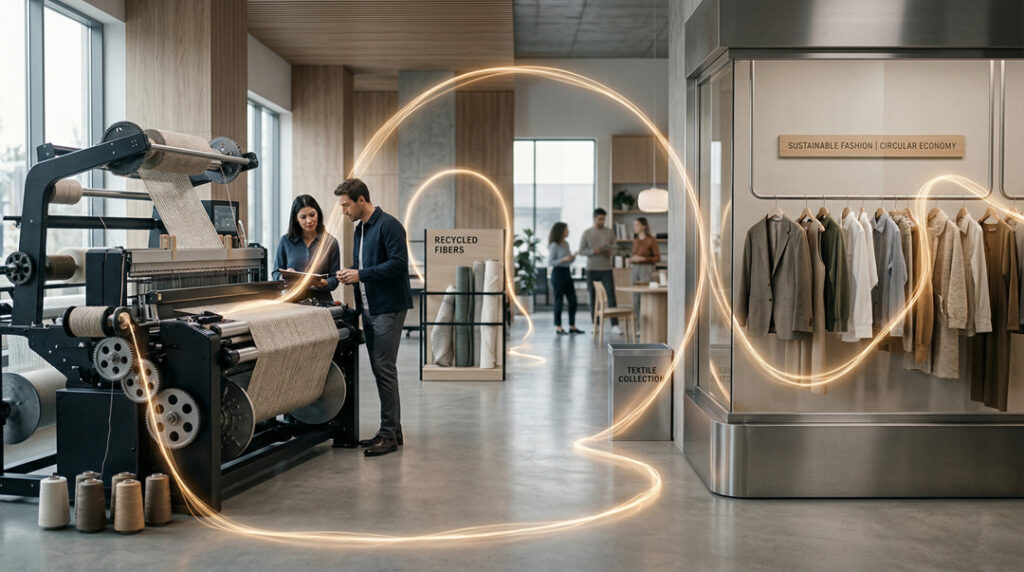
Lenzing Lends Supply Chain Support to Circ’s Fiber Club Program
Scaling circularity in the textile business is going to take collaboration. A single brand alone might not have sufficient minimum order quantities to support fiber innovation, but if multiple brands join forces and pool demand, they can reach the volumes needed to sustain material manufacturers.
This is the concept behind Circ’s Fiber Club initiative, which recently kicked off its second iteration with C&A, Madewell and Reformation. Lenzing Group also came on board this time around as a supply chain partner, along with Linz Textil. Breaking down barriers to adoption, the collective action is designed to bring circular materials one step further in their commercialization journey.
“With Circ’s technology proven, the next phase of scaling is to lower the barriers to commercialization,” said Peter Majeranowski, CEO of Circ.“Brands are increasingly facing pressure from the market to reduce waste and use better materials, and there’s a shared understanding across the industry that the status quo can’t continue. The Fiber Club model operates within existing manufacturing systems to address the costs and complexity that have held brands back, making circular materials viable today.”
The participating brands will use TENCEL™ | Circ with REFIBRA™ technology fibers. These lyocell fibers contain 30 percent Circ pulp, which is made from poly-cotton textile waste. Circ’s technology allows these blended fabrics to be separated into cellulose and synthetic materials, unlocking recycling streams for multi-fiber textile waste.
Linz Textil will serve as the spinner, creating yarn from these fibers. The brands will nominate their own fabric and garment producers, allowing them to work with familiar partners. All three brands are already using TENCEL™ Lyocell, so this enables them to easily incorporate Circ-containing TENCEL™ into their collections. Through their supply chain networks, the brands will help create wider manufacturing usage of Circ fibers.
The ultimate goal of the club is to move from pilot programs to commercial collections, eventually inking long-term fiber purchasing agreements, which are imperative in supporting next-gen materials suppliers’ investments. The current stage of this round remains a limited-volume pilot.
The first round of Fiber Club launched in January 2025 with Bestseller, Eileen Fisher, Everlane and Zalando.
“We’re excited to support transforming textile waste into new possibilities and collaborate with peers on solutions that move the industry forward,” said Katie O’Hare, vice president of sustainability at J.Crew Group, Madewell’s parent company.
Circular action is reaching a tipping point. Extended producer responsibility legislation is regulating textile waste, putting the onus on retailers to deal with their products at end of life through recycling and take-back programs. With added pressure from consumer demands, the need for commercially ready solutions is clear.
The Fiber Club is just the latest in a series of Lenzing collaborations on circularity, as the fiber maker aligns with both upstream and downstream partners to boost textile-to-textile recycling.
“True circularity in textiles won’t happen through pilots alone—it needs collaboration and scale,” said Jemma Breen, director global brands and retailers at Lenzing Group. “Fiber Club is an important step in bridging that gap, and we’re proud to partner with pioneers like Circ to help brands integrate circular materials into existing supply chains. By lowering the barriers to commercialization and working within proven fiber types like TENCEL™ and the REFIBRA™ technology, we hope to turn ambition into real, scalable adoption.”