


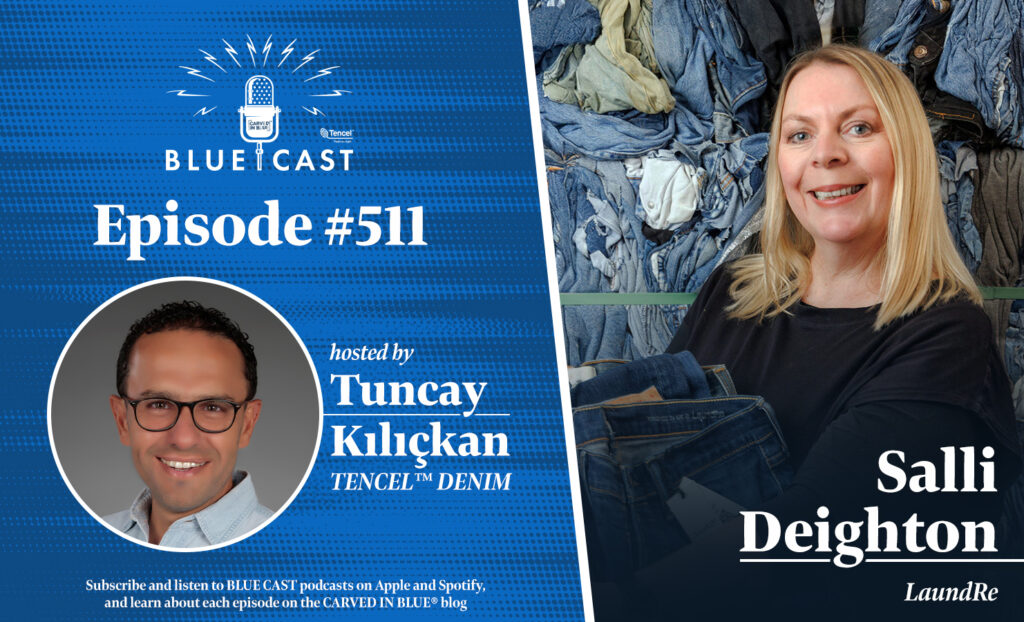
Blue Cast: LaundRe’s Salli Deighton on Building Her Onshore Finishing Hub
Blue Cast is a podcast series from the TENCEL™ Denim team. Each episode features a conversation with a special guest from within the industry or the fringes of the denim community. The following is a recap of Episode 511.
Salli Deighton’s roughly 35-year career in denim has taken a number of turns, from brand-side designing and development for labels like Wrangler and Lee to consulting for retailers like Tesco, Asos and Marks & Spencer. Her latest chapter is LaundRe, a venture that is bringing denim finishing back to the U.K.
In more recent years, production has migrated offshore, but this wasn’t always the case. When Salli began working in denim around 1989, a fair amount of development and production was still happening in the U.K. She would visit the laundries, which gave her a firsthand look at how jeans get made.
“I’m one of these people who is a bit of a geek—I think a lot of us in the denim world are quite geeky—and I have to know everything about what I do,” Salli told host Tuncay Kilickan during the most recent episode of our Blue Cast podcast.
LaundRe’s onshore positioning fulfills the need for quicker turn, more responsive production. This not only allows for flexibility in initial production runs, but also lets companies refinish or tweak items that might not be selling as successfully. For instance, merchandise could be rewashed to a different denim shade or turned into shorts or cropped styles.
From a seed of an idea seven years ago, the plans for LaundRe were finalized about four years ago during Covid. The last two-and-a-half years have been focused on fundraising, which presented some challenges. For one, the investment space in the U.K. is tight, and it is even more difficult for female founders to get funding. LaundRe is not yet operational, which means the proof of concept was less tangible for investors to see—even though it had 1.5 million pounds of pre-orders from brands.
Despite this financing “rocky ride,” LaundRe was able to raise 1.2 million pounds during the end of 2024. It’s recently signed a lease on a 7,000-square foot space in London near Canary Wharf that will have a textile recycler and a resale business on site. This facility will have a few machines and an office, and the top floor will house a showroom and educational space.
The goal is for LaundRe to become a hub for the industry, blending laundry services with workshops for executives as well as students. The London location will make it easier for larger groups of brand representatives to be a part of the development process, since it won’t require a plane ticket. With a maximum capacity of 1,000 pieces per day, LaundRe will be able to offer low minimum order quantities that small- and medium-sized brands need, while also enabling larger brands to test and iterate in smaller runs. If brands need larger scale production, they can then take the “recipe” overseas to bigger factories.
If everything goes well with the initial LaundRe facility, Salli noted the potential for a second, bigger site. “We have to prove ourselves. We’re the first of our kind for production in this country,” said “If we do the job right, people see how it works.”
Along her travels throughout her career, Salli has witnessed some “horror stories” within denim factories, including the harsh chemicals that have been used to create looks. Sustainability has been a passion point for her even before LaundRe, but this is something that is central to the startup’s mission. Although LaundRe would be internally motivated to seek out greener options, its U.K. location mandates the avoidance of materials like pumice stones.
LaundRe is also exploring what it can do to reduce waste and provide an onshore option to help brands meet extended producer responsibility regulations. A pilot project with recycler LMB gave LaundRe a grant to sterilize and refinish 25 tons of used, dirty denim. The results show promise.
“The recyclers are sinking under stuff at the moment, waste is horrific,” said Salli. “If we can refine our services, and we’re going to continue our R&D research ourselves on this. And if we get to a point where we can help the textile recyclers, there’s a whole new channel there.”
Listen to the episode here.