


Blue Cast: Reverse Resources’ Nin Castle on Textile Waste Matchmaking
In circularity, waste is a valuable commodity. But it can be a challenge to both source and sell high-quality post-industrial waste.
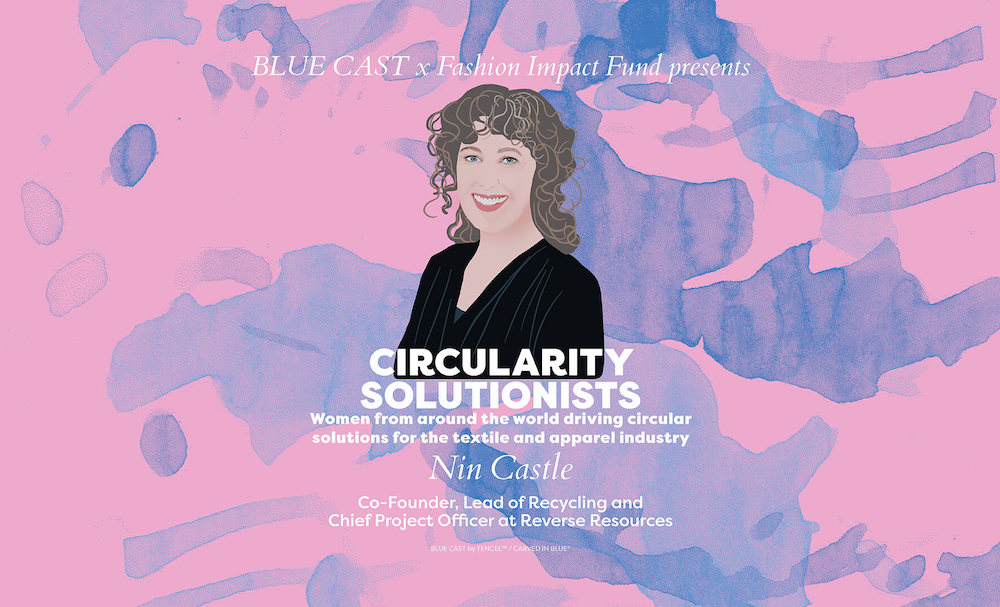
Nin Castle, the fourth and final guest on our Circularity Solutionist podcast series in partnership with the Fashion Impact Fund, has been working in textile waste for around two decades. While a fashion design student in the late ’90s and early 2000s, she started to see fast-fashion’s impact on consumption, which sparked her interest in waste. “I’ve worked really with textile waste from many different perspectives, and over the years, began to realize how important it is to have data on waste, and also how important it is to have systems in place to organize, standardize and categorize waste to really build efficient supply chains and enable waste to be reused and recycled,” she said.
In 2017, Nin joined Reverse Resources, and she is the company’s co-founder, lead of recycling and chief project officer. Reverse Resources is a SaaS platform that connects firms who have waste with those who will buy it. This trading allows more value to be created out of textile castoffs such as cutting scraps.
For instance, changing how cutting room discards are processed could make them more salable. Instead of tossing them on the floor, putting them in bins can keep them from becoming contaminated and dusty. Factories can also keep each type of fabric to its own bin, allowing for easier processing at the recycling stage.
Currently, Reverse Resources is tracking and trading 300 tons of textile waste per month through the platform. And it has projects in the works to scale this figure in the next half year. The company is also developing a public dashboard to share information.
In switching from conventional to circular systems, everything is more interconnected. Whereas in a one-way linear chain, entities only engage with their direct neighbors, in circular supply chains, “What goes around comes around,” Nin said. “It’s a cultural shift that needs to happen for organizations to understand that their actions have consequences for around the supply chain, and perhaps even back to them.”
Brands are responsible for two roles in this system related to supply and demand. Firstly, Nin sees companies buying recycled fibers, establishing a demand for these materials. Where there is still room for growth is in helping to facilitate and support waste streams that can be recycled. One example would be designing for circularity.
Much attention gets placed on the conditions in apparel factories, but Nin noted that those working in waste often have it worse. “A big elephant in the room is the social compliance in the waste handling sector,” she said.
A challenge to improving social responsibility is an inadequate number of compliant waste handlers to meet recyclers’ demands. To tackle this issue, Reverse Resources is developing a code of conduct for suppliers. “You don’t have to be perfect to start working in the network,” Nin said. “But you have got to show willingness to improve.”
Listen to the episode here.