


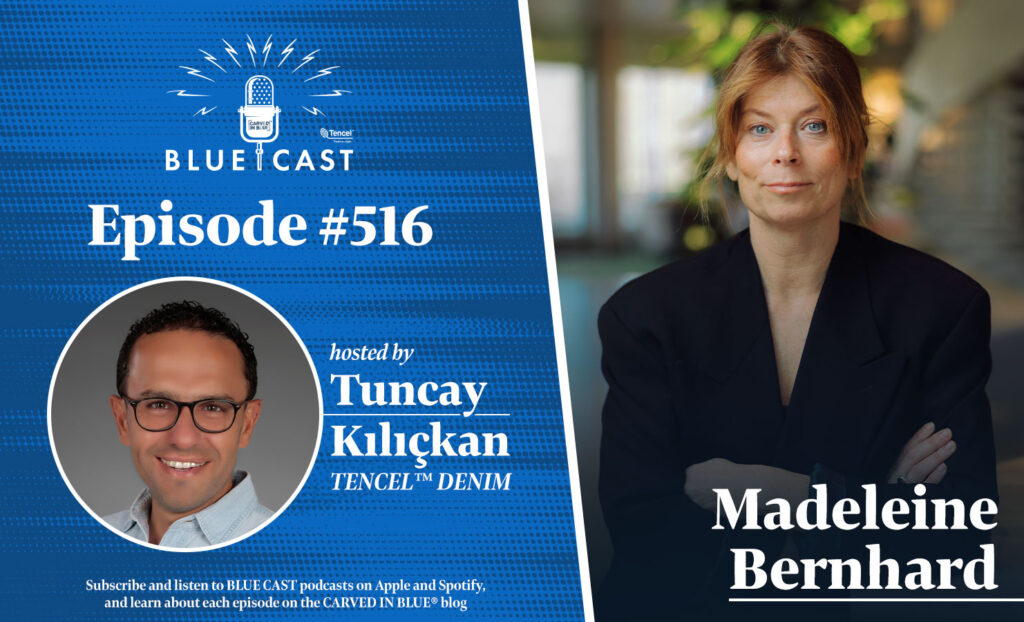
Blue Cast: Södra’s Madeleine Bernhard on Scaling Circularity and Supply Chain Cooperation
Blue Cast is a podcast series from the TENCEL™ Denim team. Each episode features a conversation with a special guest from within the industry or the fringes of the denim community. The following is a recap of Episode 516.
Man-made cellulosic fibers and paper may both be made from trees, but where they diverge is the accessibility and scale of recycling. Decades ago, paper recycling took off, and today 70 percent of paper is recycled. Yet textile reuse has lagged, and currently only 1 percent of fabric enters a closed loop.
Sweden-based forest owner organization and wood-based material supplier Södra is looking to boost this figure with its OnceMore pulp product. Launched in 2019, OnceMore blends wood pulp and textile waste into a pulp that can be used as an input for the production of viscose and other MMCFs. Lenzing Group has supported and partnered with Södra on the R&D around OnceMore, and we have used OnceMore as a material for fibers made with our circular REFIBRA™ technology.
On the latest episode of our Blue Cast podcast, Lenzing’s Tuncay Kilickan chatted with Madeleine Bernhard, business development manager at OnceMore from Södra, about her company’s efforts to grow circularity. Currently, OnceMore has a capacity of 6,000 tons, enough to make roughly 23 million garments. But the goal is to scale this to 60,000 tons. Additionally, OnceMore today has an average of 20 percent recycled content, but the aim it to raise this to 30 to 50 percent, incorporating and reusing more textile waste.
“We have the muscles, we have the knowledge…and we are resilient, but we want the market to be there,” said Madeleine. “And today, the market is not there.”
Madeleine noted that demand is a prerequisite for scaling. Although some demand exists, and it is slowly growing, it is not where Södra was hoping it would be. Brands are interested, but they often have questions about price and are focused on profitability alongside sustainability. To add to that, there are hesitations about consumers’ willingness to pay.
Complexity also comes from the multiple areas of an organization involved. “There are sustainability departments, there are sourcing departments and buying departments, and you need to have all of them on the right path,” Madeleine said.
What could nudge brands and the supply chain further along the circular path is legislation. For instance, Denmark and the Netherlands are both discussing proposals that would make the inclusion of recycled material compulsory.
One valuable aspect of OnceMore’s technology is its ability to process polyester-cotton blends. As long as a textile is cotton-rich—and therefore rich in cotton’s building block cellulose—the polyester can be separated out before the material is turned into pulp. Additionally, while OnceMore was previously limited to textiles in white or bright hues, now it can use inputs in a wider shade range.
As Madeleine noted, Södra has partnered with academia and other players in the industry, including Lenzing, on the development of OnceMore. To expand circularity, it’s going to take collective action. “We need to do this together, both the consumer, the brands, as well as the textile manufacturers,” she said.
Listen to the full episode here.