


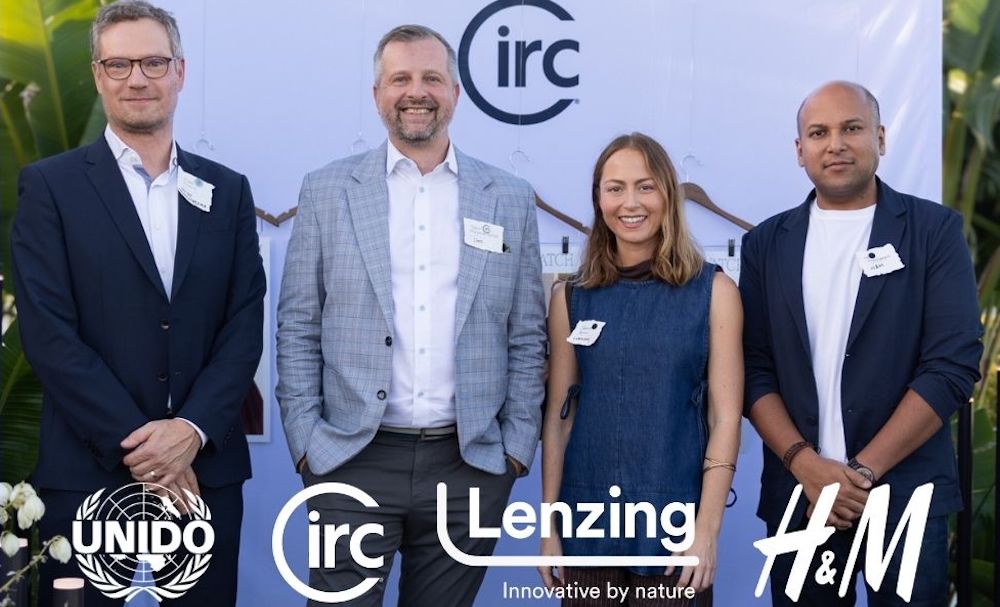
Circ’s Cellulose is Becoming H&M Denim in a TENCEL™ Team Up
One of the historic obstacles in creating a more circular fashion industry has been blended materials. Prevalent polyester-cotton mixed fabrics pose a problem for recyclers, since the two fiber types cannot be processed the same.
U.S.-based textile-to-textile recycler Circ has created a hydrothermal processing method for polycotton waste that can separate these two fiber types so that blends can successfully be recycled. The cellulose pulp recovered can be turned into lyocell, giving it a new life, while synthetic materials become new polyester.
Lenzing Group is helping to scale and commercialize Circ’s technology by using its cellulose pulp as an input for its TENCEL™ fibers made with REFIBRA™ Technology, which allows textile waste to be used in addition to wood pulp in the making of the fibers. The resulting TENCEL™ | Circ® with REFIBRA™ Technology fibers incorporate 30 percent Circ pulp.
Bringing Circ’s technology to retail, H&M has begun incorporating the startup’s recycled materials into its garments. This fall, it is introducing a v-neck fleece sweatshirt for women that includes Circ polyester. And next spring, H&M will release men’s denim made with the TENCEL™ | Circ® with REFIBRA™ Technology fibers. Sample garments from this collection were on view at the Textile Exchange conference in Lisbon in October.
“True circularity will require the entire value chain to work together,” said Florian Heubrandner, executive vice president commercial textiles at Lenzing Group. “By integrating Circ’s® recycled pulp into Lenzing’s REFIBRA™ technology and partnering with H&M Group, we’ve demonstrated how existing mill relationships and fiber platforms can be leveraged to make circular fashion commercially viable.”
The entire value chain got involved in creating these products. For the denim, Pakistan’s AGI Denim took Lenzing’s fibers and wove them into fabric. And on the polyester front, H&M worked with Palmetto to transform the Circ PET chips into staple fiber, which were then turned into fabric by Fakir Knitwear. Circ’s raw materials are designed to drop into existing textile processes, making the switch from virgin to recycled inputs more seamless.
“H&M Group brings global fashion scale, and Lenzing brings decades of fiber expertise,” said Peter Majeranowski, CEO at Circ®. “Together they provide the infrastructure needed to make circular fashion commercially viable. By working with partners of this caliber, we’re showing how fiber producers and global brands can close the loop at commercial volumes.”
This collaboration builds on the existing work being done by H&M and Circ through the Switch to Circular Economy Value Chains (SWITCH2CE) initiative, funded by the European Union and the Government of Finland. In an H&M pilot program in Bangladesh, the retailer is testing collection, sorting and recycling solutions for polyester and cotton textile waste.
“Collaborating with key partners on projects like Circ® is essential to our vision: to grow our business decoupled from resource use and extraction, with products and materials circulating at their highest value,” said Cecilia Strömblad Brännsten, head of resource use and circularity at H&M Group.