



Egyptian Denim Manufacturers on the African Nation’s Attraction
In recent years, Egypt has become a key center for denim production, and it has attracted investment from manufacturers based in other countries.
A number of Türkiye-based manufacturers have made moves to the North African country just across the Mediterranean Sea. In 2011, Taypa opened the T&C Apparel and Washing Facility, which today has a workforce of more than 5,000 and an annual capacity of 15 million garments. 2011 also saw the opening of DNM Denim in Damietta, Egypt, which was funded by Turkish based Eroğlu Global Holding. DNM creates millions of meters of fabric with sustainability as a North Star.
Meanwhile, Sharabati Denim—originally based out of Syria—now has its headquarters and production in Egypt with an additional manufacturing footprint in Türkiye.
Here, executives from DNM Denim, Sharabati Denim and Taypa discuss the opportunity in Egypt and how they are advancing their operations there.
DNM DENIM

Gökhan Ünsal, general manager
Carved in Blue: Why has Egypt become such a hotspot for denim manufacturing?
Gökhan: Egypt has emerged as a leading hub for denim manufacturing due to several strategic advantages.
First, it has a strategic location. Egypt benefits from duty-free or reduced-duty access to both the European Union and the United States through trade agreements such as QIZ (Qualifying Industrial Zones). Its location at the crossroads of critical global sea routes, including the Suez Canal, ensures efficient shipping logistics to major markets.
Egypt also offers a relatively lower cost of production compared to neighboring countries in the region, making it an attractive option for manufacturers seeking cost savings without compromising quality.
The availability of numerous Free Zones provides tax incentives and reduced bureaucratic hurdles, fostering a more business-friendly environment for international investors.
Lastly, compared to some regions in the Far East, Egypt offers a relatively stable political and economic environment, reducing risks associated with manufacturing operations.
Carved in Blue: What about the country makes it a great place for denim factories?
Gökhan: Egypt combines historical expertise with modern infrastructure to support the denim industry.
Egyptian cotton, particularly the long-staple Giza variety, is renowned globally for its softness, strength, and durability, making it ideal for high-end denim production.
While finding technical experts can be challenging, the country has a long history in textiles, providing a solid foundation of skilled labor for denim manufacturing.
Egypt also has eco-friendly potential. Many factories in Egypt are adopting sustainable production methods, such as water-efficient dyeing processes and renewable energy sources, aligning with global demand for environmentally responsible products.
Carved in Blue: Are there any challenges of operating out of Egypt?
Gökhan: While Egypt offers significant advantages, there are challenges to consider.
Setting up operations within Free Zones can take time due to complex regulations that require companies to adapt to specific compliance standards.
All raw materials, dyes, chemicals, and spare parts must be imported via shipping routes. This dependency can lead to delays, especially in the face of global supply chain disruptions.
It can be difficult to find experienced technical staff locally, requiring companies to invest in training or recruit expertise from abroad.
Carved in Blue: Why should companies consider sourcing their denim from Egypt if they aren’t already?
Gökhan: Egypt offers a compelling value proposition for denim sourcing.
The use of Egyptian cotton ensures superior fabric quality, which is increasingly demanded by discerning consumers.
Many Egyptian factories are integrating environmentally friendly practices, addressing the global push for sustainability in fashion.
There is also proximity to major markets. Shorter lead times to Europe and North America make Egypt a strategic choice for brands looking to reduce inventory risks and respond quickly to market trends.
Carved in Blue: Where are your clients predominantly based? And what regions are you targeting for growth?
Gökhan: Our clients are primarily based in Europe and North America, markets known for their focus on quality and sustainability in denim products. Moving forward, we are targeting the Asia-Pacific region and Africa for growth, as these areas present untapped potential and are witnessing a rise in consumer demand for premium denim.
Carved in Blue: How are you investing in your operations to better serve the denim industry?
Gökhan: We are committed to enhancing our capabilities to serve the denim industry more effectively.
We are developing our infrastructure, upgrading machinery and introducing advanced technologies to optimize production efficiency and quality.
Our sustainability initiatives include investing in water-efficient dyeing techniques, renewable energy sources, and waste recycling systems to align with global sustainability standards.
We are also implementing robust training programs to upskill our workforce and address the shortage of technical expertise.
Finally, we are undergoing digital transformation, integrating digital tools to streamline supply chain management and improve responsiveness to client needs.
SHARABATI DENIM

Alessandro Moretti Ciacci, sales and marketing director
Carved in Blue: Why has Egypt become such a hotspot for denim manufacturing?
Alessandro: Following the strong cost increases in Türkiye and Tunisia, there has been a search for possible nearshoring garment manufacturing from brands and customers. There, Egypt comes into play. There is already a supply chain; it may be to be further developed, but you can start operating immediately. And costs are interesting when compared to other Mediterranean jeans countries.
Carved in Blue: What about the country makes it a great place for denim factories?
Alessandro: On top of the interesting costs in terms of manpower—which is essential for garment makers—the country is stable, self-sufficient, and has a huge growth potential, both for export and local market, with 110 million people.
Carved in Blue: Are there any challenges of operating out of Egypt?
Alessandro: For sure, the supply chain has to be developed and improved. Also, the quality level in general needs to be fine-tuned. But, with a proper know-how and a specific on-site management, such problems can be solved. Also to be considered is the administrative bureaucracy, where a local person managing the factory is to be strongly thought of as a partner.
Carved in Blue: Why should companies consider sourcing their denim from Egypt if they aren’t already?
Alessandro: The relation between price and quality is probably unique at the moment. And it is surely the place for future garments production close to Europe and with easy access also to several ports for shipments overseas.
Carved in Blue: Where are your clients predominantly based? And what regions are you targeting for growth?
Alessandro: Our clients are mainly in Europe. Our target is to increase the customer base in Europe as well as to improve our penetration in the USA.
Carved in Blue: How are you investing in your operations to better serve the denim industry?
Alessandro: Sharabati has always strived for efficiency, and we are following this. Be it machineries, people, energy, trends, we keep investing in new technologies under all aspects.
Efficiency means to deliver the appropriate service, within sustainable standards. Being efficient is part of the pillars of sustainability.
TAYPA
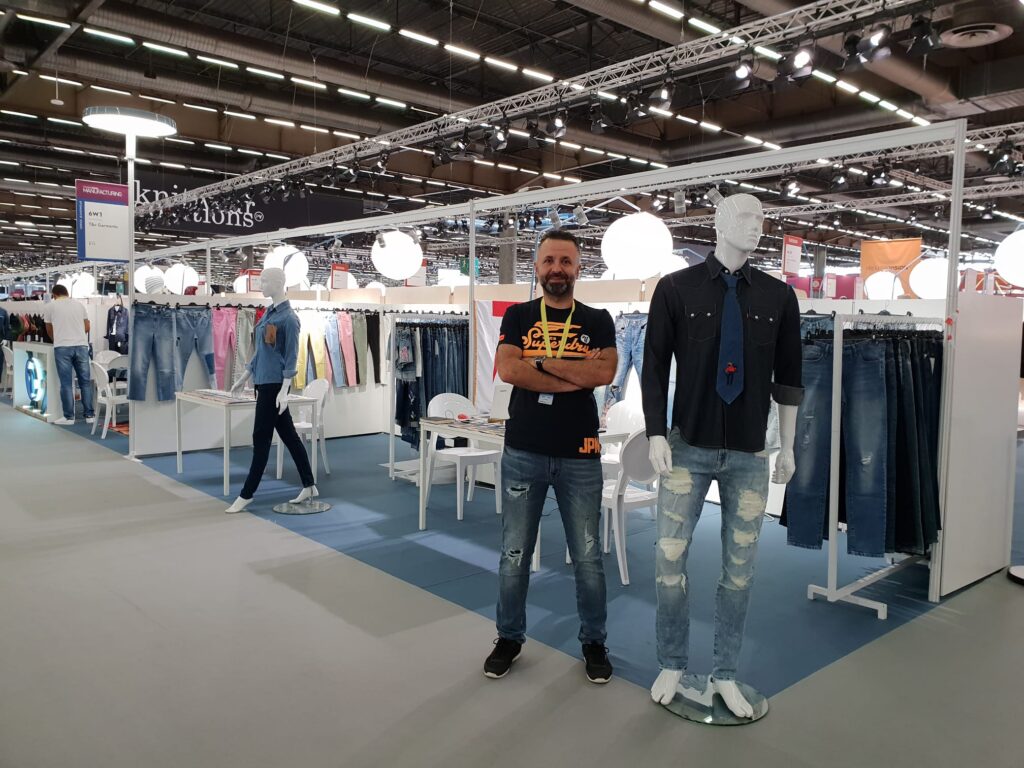
Erdem Korkut, Egypt sales & marketing director
Carved in Blue: Why has Egypt become such a hotspot for denim manufacturing? What about the country makes it a great place for denim factories, and why should companies consider sourcing their denim from Egypt if they aren’t already?
Erdem: To answer, we need to look at the current situation from both brand and manufacturer sides.
From the brands’ side, as you know, the world has been facing many challenges since the last couple of years with Covid, inflation, wars, etc., and we can extend the list. Those difficult times showed brands how important nearshore sourcing is as well as how dangerous sticking to one country for sourcing is. Considering Egypt is a close location with very short transit time to both the U.S. and EU, brands considered moving some of their orders to Egypt to be more flexible against unexpected situations.
On the other side, Egypt has many other advantages such as being closer to supply chain in Türkiye, giving duty free advantage to brands, competitive pricing, a young population and more.
If we look from the manufacturers’ side, because of the high increase in costs in Türkiye vendors started to look for alternative production regions. And due to above mentioned reasons coming from the brands’ side, Egypt became the most advantageous location for manufacturers, so they started to plan investing in Egypt to move their production from Türkiye.
Carved in Blue: Are there any challenges of operating out of Egypt?
Erdem: There are many challenges as well as advantages. Even though Egypt is becoming a famous destination for garment sourcing, the supply chain in Egypt is not complete yet. You have to bring most of the raw materials from out of the country. We are trying to get over this challenge using the suppliers in Türkiye.
On the other side, new coming vendors should always keep in mind that bureaucratic procedures can take much longer than they expected.
Carved in Blue: Where are your clients predominantly based? And what regions are you targeting for growth?
Erdem: We have a quite wide range of customer base. Even though our main customers are from the U.S., we are serving well-known EU brands as well.
Carved in Blue: How are you investing in your operations to better serve the denim industry?
Erdem: Denim is a dynamic industry, and if you stop investing, you will have low chance to live. Almost everyday, a new technology comes up and to better serve the brands, you need to have it. We are constantly renewing old machinery as well as putting new technologies to the factory. Considering that we are producing almost 1.5 million pieces every month, we always think of technology and automation.
In addition, when serving the denim industry, we should not forget to serve the environment as well. So, we became the first and only one in Egypt setting up a laundry water recycling system. Also we have solar panels, we are using hi-tech laundry machines working with less water, hi-tech lasers, e-flows, etc.