


Heddels: Raw Passion and Resourceful
How has curiosity and enthusiasm for artisanal denim evolved into Heddels, one of the most in-depth resources in the industry?
First launched in 2011 by Nick Coe (founding editor) and David Shuck (managing editor) as “Rawr Denim,” Heddels is one of the most wide-ranging resources on the raw denim market. The website offers well researched stories, including product releases, educational guides and editorials, as well as other features, like The Scout, a database of some 4,000 raw denim jean products, and The Store Guide, a powerful search tool for finding a retailer based on location or brand.
Carved in Blue caught up with David to find out more about the inspiration behind the project, plans for the future and his thoughts on premium and raw denim.
Carved in Blue: What is your background in denim?
David: None, besides being an enthusiast! We came in purely from the consumer point of view without any formal training or commercial experience in fashion whatsoever. My passion for denim was born out of a trip I took to Japan some years ago and was first exposed to artisanal brands reproducing classic American jeans from the mid-twentieth century. I wanted to know how and why, which pushed me to start doing my own research and fall down this rabbit hole of the denim world.
Carved in Blue: What was the inspiration behind Rawr Denim?
David: Rawr Denim was conceived as a way to make raw selvedge denim more accessible, as sort of a “Wikipedia for jeans”, which would have all the information you needed to understand how to buy, wear, and repair raw denim as well as why you should.
Before Rawr Denim, the only way to learn about jeans online was via message boards like SuperFuture and Styleforum, both of which are phenomenal resources but aren’t the most navigable places on the internet. If you wanted to learn about a specific brand, it often required trawling through dozens and dozens of pages of comments and speculation as to their origin. We wanted to find all the good bits available on sites like that and turn it into a readable and actionable resource.
Carved in Blue: Why do you think that focusing on fades is so appealing to denim geeks these days? What is it about denim that invites this type of deep cut?
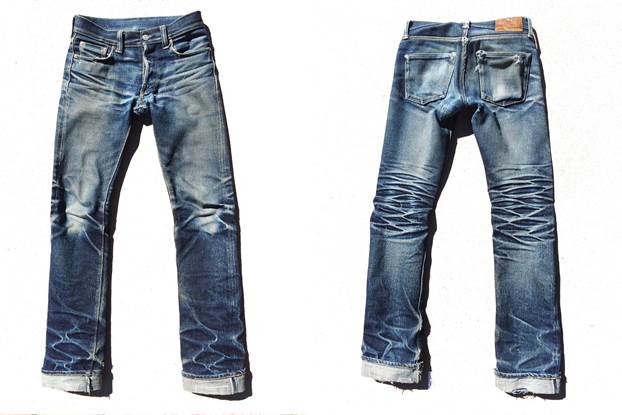
David: Raw denim is really a blue collar science project when you think about it — everyone can buy the same pair but no two will turn out alike. This is something unique to raw denim, as opposed to a coffeemaker or a watch or a car or any other consumer good. So if you do own the same pair of jeans as someone on a fade feature, it’s fascinating to see how theirs turned out differently than yours. And even if you don’t, it’s fascinating to see how a jean transforms and what it could look like if you were to take it for a spin.
Carved in Blue: Why did you change the name from from Rawr denim to Heddels?
David: The name change was one of the most difficult decisions in the history of our company, but the fact of the matter was that we felt we had accomplished our mission of making raw and selvedge denim more accessible through education and information. On our journey, we discovered a whole world of other makers, products, and cultures that followed the same ethos that attracted us to raw denim — long lasting, well made, evolves with time. We wanted to be able to tell those stories, but felt constricted by a name like Rawr Denim, which as a masthead limited the legitimacy of the topics we could cover. The name Heddels is derived from “heddle”, the piece of the weaving loom which holds the warp yarns in place — it’s a nerdy detail that serious denimheads will pick up on, but we feel will allow us to explore all the thematically similar ideas we’d like.
Carved in Blue: What void do you feel needs to be filled in the denim media arena?
David: I think there’s not enough media aimed at the casual consumer. Denim is something that most everyone wears but very few people know anything beyond the surface level. Consumer awareness — about where it comes from, why it’s designed in such a way, and how it’s made — is essential to producing good product that’s also ethical and environmentally friendly. I think this would likely come in rich media content — videos, podcasts, photoshoots — that highlights these ideas in ways that engage lay-consumers more readily.
Carved in Blue: Do you see a push for more sustainable denim and fibers?
David: Absolutely. I think it’s great that more people are becoming aware of the global impact of their purchases, especially surrounding what they wear. I can only predict more and more people demanding sustainable fashions as they realize the true cost of what they buy.
Carved in Blue: In your estimation how much of the men’s business has gone from rigid to stretch? Do you see more business going back to rigid?
David: In our section of the market, it’s really quite minimal. I think stretch is a function of fit, and as fits became slimmer and slimmer the only way many people would or could tolerate it was with stretch denim. Fits are waxing currently and I see leg openings only getting bigger for at least the next 2-3 years so I see less need and ultimately less demand for stretch in the future.
Carved in Blue: What trends to you see happening for fall 2017 and spring/summer 2018?
David: Aside from roomier fits as mentioned above, I think sustainability and environmentally responsible denim is only going to become more popular. Fast and disposable fashion is sort of on overload, I see more and more consumers ready to make a commitment to the things they buy. I’m remiss to call “quality” a trend, but I think it’s something that people are ready to pay attention to again.
Carved in Blue: Do you believe the denim business can be scaled in a meaningful way in the USA?
David: Difficult to say. It’s hard to imagine a future where most American consumers are willing to pay $200 or more for a pair of jeans, so denim production will only return to the US when it’s cheaper to do it here than it is anywhere else. When that happens is likely going to be when the cost of automation is cheaper than the cost of foreign labor plus shipping, plus tariffs. Who knows if that’s going to be in five years or fifty, but it’s certainly not going to be the rosy, union-made ideal that many made in USA fans might imagine.
Carved in Blue: What’s next for Heddels?
David: We want to position ourselves as the go to resource for all things made to last and believe people should own things they want to use forever. And we want to enable a new generation of consumers with the information they need to make the choices that are right for them.
Carved in Blue: What’s your favorite pair of jeans?
David: Currently, my daily wear is a pair of The Real McCoy’s 991-BK. It’s the only double black unsanforized selvedge denim I’ve seen and the 991 cut is just about the perfect fit for me.
Carved in Blue: What is the worst trend you’ve seen in denim?
David: Several years ago, everyone and their dog was doing a Kickstarter for “premium selvedge denim direct to consumer”. A few good brands were born out of this period, but many of these folks had no experience in garment production, nor had any idea how to make the jeans once they had their funding and many consumers were left in the lurch. I think this period really damaged the integrity of the industry as a whole and burned many first timers on their experiences with raw denim.
Carved in Blue: What is a premium jean?
David: “Premium” is a term that means something different to everyone and is thrown around so much it’s nearly impossible to define. I’d say something becomes premium when it’s no longer a commodity and you’re paying for some other quality that speaks to you personally rather than for its explicit purpose.
For denim, that’s any embellishments or extraneous feature beyond the bare necessities you need to call it a jean – five pockets, fly, belt loops, denim fabric, etc. If it’s distressed, that’s premium; if it’s selvedge, that’s premium; if it has hidden rivets, that’s premium. I know that sounds quite austere, but when everything is “premium”, the realm of what is and isn’t is entirely in the mind of the consumer.
Carved in Blue: What does “Carved in Blue” mean to you?
David: Carved in Blue is an incredibly helpful resource for understanding the upstream denim market, particularly with regards to new fiber development and sustainability. The world of commercial textile manufacturing can be a daunting subject even for industry vets, but Carved in Blue’s broad coverage makes it comprehensible for even a layperson.