



How Seed of Joy’s Sweaters Were Knit Together
Indigo dye is widely used in denim, but the same hue has been more difficult to translate to certain categories. For instance, sweater knit manufacturers have usually shied away from indigo since yarns in the rich blue would stain their machines.
Lenzing’s TENCEL™ Modal with Indigo Color technology eliminated this issue. These fibers are dyed before they are spun, so the pigment is locked in rather than applied on the surface. This results in vastly reduced crocking, or color transfer, making indigo suitable for sweaters.
To launch TENCEL™ Modal with Indigo Color technology, Lenzing worked with designer Adriano Goldschmied and a number of collaborators on a collection called Seed of Joy. Among the partners in the project was Shima Seiki, which specializes in knitting machines, including Wholegarment 3D knitting technology that eliminates seams and production waste.
In a recent webinar hosted by Shima Seiki, Adriano and Lenzing’s Tricia Carey came together to discuss how the sweaters in the collection were made.
“I feel like my mission is to be an indigo lover and an indigo ambassador,” said Adriano. “My mission is also to try to bring the indigo idea and the indigo concept to categories that in some way have never been touched before—most of the time because of technical reasons, but sometimes also because two worlds are very different.”
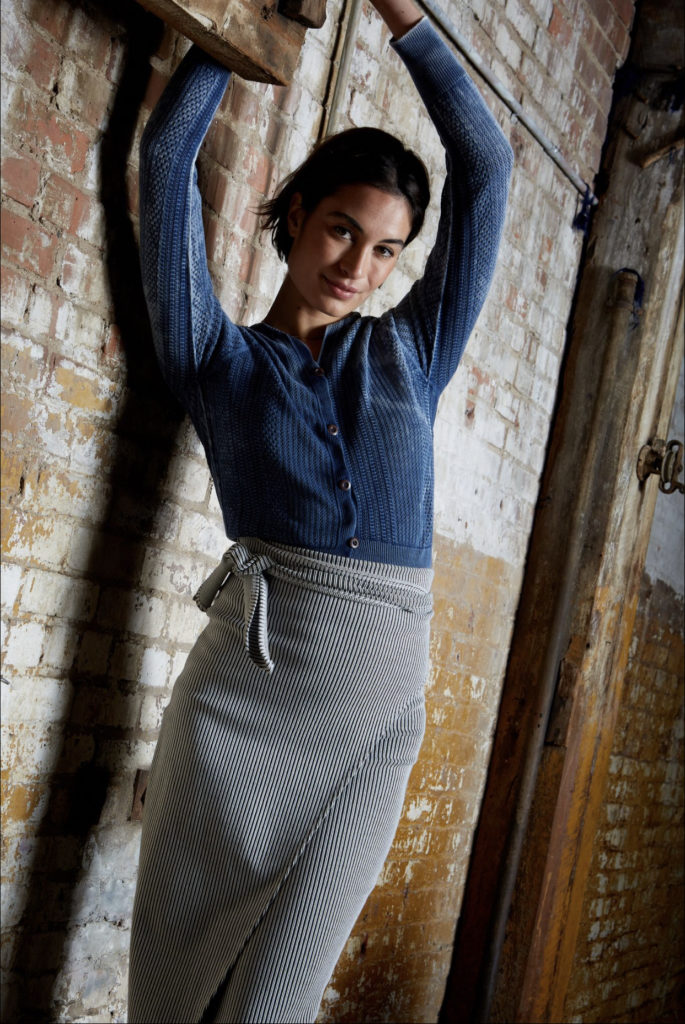
Hayato Nishi of Shima Seiki called the spun-dyed TENCEL™ fibers a “gamechanger” for flatbed knitting. Together with designer Aran Baik, Shima Seiki developed three different styles for Seed of Joy: a cable turtleneck, a crewneck with mixed knit structures and an open knit cardigan with pointelle detailing. These sweater knits were designed virtually, programmed and then produced on Shima Seiki’s Mach2XS machine.
After wash panels were made, the samples were sent to Adriano and denim laundry Tonello for washing tests. The knits offered expanded opportunities in wash treatments, but it was also a new frontier since the pigment was embedded in the fibers. This required some trial and error to get finishing right. Because of the way the TENCEL™ Modal with Indigo Color technology fibers are dyed, they can be lasered to add prints, offering a novel treatment option. The sweaters in the Seed of Joy collection were treated with ozone, and the knit designs’ structures took to the treatment.
Because indigo sweaters were a new territory, shared expertise became even more important. Additionally, Adriano’s background in both knits and wovens was valuable in getting the desired washing effects. “Knitters haven’t traditionally liked working with indigo yarns,” said Tricia. “The woven side of the business doesn’t really understand all the knits, so it kind of falls in that grey area. And that’s where it really can come together with the experience that [Adriano] brings.”

The panelists noted that Seed of Joy just scratched the surface on the potential for TENCEL™ Modal with Indigo Color technology.
“This was a seed of joy,” said Hayato. “We hope that this seed is planted in these designers’ minds, and hopefully we can see more applications moving forward, not only in apparel, but more industries down the line as well.”
Watch the webinar below to learn more about Seed of Joy and the collaboration behind the project.