


Industry Experts Weigh in on Winning Water-Saving Solutions
Water is one of the most precious natural resources, but the industry hasn’t always treated it kindly. Following wakeup calls about the waste and scarcity that stem from water-intensive processes, denim makers are developing methods that reduce their water impact.
Carved in Blue asked industry insiders to share what technologies they feel have been most impactful. Read part four of this series—featuring executives from Artistic Fabric Mills, LaundRe, Crystal International and Officina+39—below for insights on what is driving progress.
Farah Iqbal Baigmohammed, managing director, Artistic Fabric Mills

At AFM, we’re proud to have pioneered O3 Technology, a significant leap forward in sustainable textile processing. This proprietary system enables zero water wastage across all three wet textile stages: dyeing, finishing and laundry.
What makes O3 unique is its ability to use water solely to dilute dyes and chemicals, entirely eliminating the need for conventional washing steps. Instead, we apply a special fixation agent during the dyeing and finishing processes, replacing traditional rinsing while still achieving excellent colorfastness and fabric performance.
This groundbreaking approach has been independently certified by BluWin, a UK-based certification body known for its rigorous sustainability standards. Furthermore, a life cycle assessment (LCA) conducted by TÜV Nord confirms the broader environmental benefits of our process.
To give a sense of impact, compared to conventional methods, the O3 process delivers 92 percent total water savings per linear meter, 85 percent water savings in yarn dyeing and 93 percent water savings in fabric finishing.
O3 is not only a technological innovation—it represents our deep commitment to redefining textile manufacturing with measurable environmental benefits, without compromising on quality or performance.
Salli Deighton, CEO, LaundRe UK
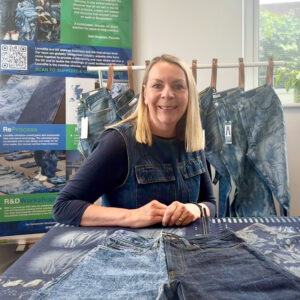
At LaundRe, the UK’s first circular, reshoring denim finishing hub, we don’t see water-saving as a single innovation, but as a series of connected breakthroughs across the denim supply chain that, when combined, deliver a positive impact for the industry.
The rise of waterless dyeing systems eliminates the need for water-based vats entirely using foam, mist or enclosed chamber application methods to apply indigo with minimal waste. Advance Denim Bigbox, in particular, shows that large-scale, clean dyeing is possible without the traditional water footprint. Wdenim also has waterless dye technology, and we are seeing this shift with many mills. As dyeing has one of the largest water impacts on the supply chain, the change to waterless dyeing is one of the most important.
Closed-loop water recycling is also a key technology in the washing or finishing stage. The ability to treat and reuse process water helps eliminate freshwater consumption and reduce impact. At LaundRe, we’ll be working on our own clean-loop water system as our business grows so every drop used stays in a regenerative cycle.
Finally, our everyday water-saving technology is ozone finishing. With our Jeanologia technology, we can reduce the steps in the finishing process, reducing our water consumption.
LaundRe has been built to be a testing ground for change, proving that circular, low-impact systems can scale, and helping lead the shift to better, cleaner, more transparent practices across the denim industry.
Janet Lui, senior manager, design and product development, denim division at Crystal International Group Limited

There are numerous methods and combinations to achieve water savings in the denim industry. However, to achieve a truly impactful result, collaboration across the supply chain is essential.
Take action at the start
Adopting a sustainable design mindset involves selecting regenerative materials and focusing on source reduction by determining product execution applications or processes, such as laser machinery, integrating laundry processing and using greener products like waterless enzymes.
Water consumption
Most enterprises have their own sustainability targets. For example, Crystal International aims to reduce freshwater intensity by 20 percent by 2030 compared to the 2022 baseline, as part of our Crystal Sustainability Vision 2030 Impact for Better.
Collaborate with brands
I believe that collaboration across the denim supply chain could have a significantly greater impact on water-saving efforts.
Challenge and future act
There is always room for improvement, such as increasing the percentage of recycled water with investment. Embracing new technology to Use Less Recycle More and educating consumers on how to choose better products by sharing sustainable concepts of reduce, reuse and recycle.
Andrea Venier, managing director, Officina+39

Water crises remain a major risk to humanity. Ninety percent of the world’s natural disasters are water related. Two billion people live in water-stressed countries.
We all know that water is essential for life. The fashion industry knows it, too.
In the denim world, water has undoubtedly always been an important—and for a long time irreplaceable—element. But in recent years, work is being done globally to reduce water consumption in all industries, including our own. The continuous search for innovative processes has led to the development of products and machinery that help reduce water consumption.
Before talking about water-saving methods, I would like to say what the next step should be. In my opinion, the real mission is to protect the purity of water from sources such as mountains as much as possible. We need to work more to develop a circular concept around water, trying to reduce consumption and [expand] reuse in the cycle as much as possible.
Key innovations include machinery and chemical products capable of working with reduced liquor ratio of the bath (from1:10 to 1:2), such as nebulizing techniques really able to reduce 70-80 percent of water consumption.
Chemicals companies like us are working to develop better chemicals day by day that are able to work in combination with the latest machines. Innovative chemicals and machines together can improve a lot the water-saving, such as reducing the steps and reducing rinsing.
But, in my opinion, the most innovative technologies in terms of water saving are the chemicals developed to work without the use of water: waterless technologies. Enzymes, dyeing and bleaching agents are some of the innovative chemicals that today we can apply in the industry in waterless conditions, using water just for rinsing steps.
There are undoubtedly challenges in relation to these products, namely that of obtaining performance products. Products used in water provide good wetting, penetration and levelling results, while products used in waterless or by nebulization systems can present these kinds of problems. And this is where chemicals companies like us, with passion and constant research, manage to combine chemistry with technology so as to present competitive products and processes in terms of wetting, leveling, color intensity and abrasion, avoiding all kinds of problems.
The simultaneous application of more innovative waterless technologies, combining the latest waterless chemicals with innovative machines, can really be a game changer for water conservation in our industry.
In Officina+39, we’re really concentrated in developing processes that can reduce water consumption. We’re calling it Aqualess Mission.
Read part three of this series here.