


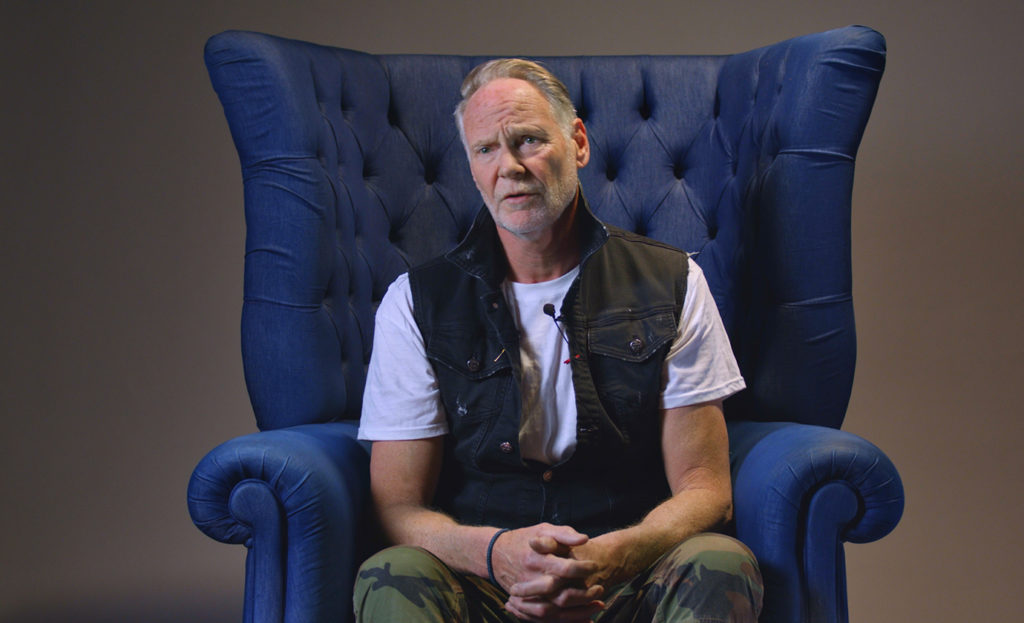
Rich Tobin Wants to Know Just How Sustainable He Can Get
Yes, denim requires a seismic shift in sustainability, but there’s perhaps no industry that’s better positioned to pull it off. Flanked by baby boomers determined to leave a strong legacy and a younger generation of ambitious, demanding denimheads, Kaltex America’s Rich Tobin, VP Sales and Marketing remains optimistic about what can be accomplished.
He talked with Carved in Blue about heritage, hypocrisy and hope within the denim world—and about being compelled to make a significant impact for his kids.
Carved in Blue: What’s the modern definition of denim today?
Rich: Friendships, relationships. For me, one of the things that really brought me into denim— other than a love for the fabric in and of itself—was the amazing community that follows the migration, if you will, of any given season, and shows up and starts with a kickoff for Kingpins Amsterdam.
I was lucky enough to attend the first Kingpins Amsterdam as an exhibitor and the next three. I took a break for one year, and I’ve been back for the rest of them. And it’s really been impressive to see how the community in Europe shows up and supports the event. But also how everyone here is very passionate about the industry. There’s a lot of unique characters and people that I look forward to seeing every six months.
Kingpins is an integral part of the industry, and I believe that the steps that Kingpins is taking and the new direction that Andrew Olah announced about creating a set group of standards that all exhibitors will eventually have to meet relative to sustainable goals and initiatives is absolutely the right move at the right moment. I think that collectively, as a group, we will have a much stronger voice than as individuals. I’m all for it.
Carved in Blue: What is the most pressing present-day issue of denim?
Rich: Sustainability. When I interviewed for the Kaltex job, I had various opportunities to work with different entities. And I chose Kaltex because they’re a vertically integrated entity, and they have very good capability that’s not always been developed to its maximum effect. So the challenge was there.
But, more specifically, I was asked what I thought the trends were, and I said that sustainability was really the only trend that mattered. Having five children and being on the young end of the baby boom generation in America, at 58, I feel very compelled to do something significant, to the best of my ability on my own, as well as collectively with those in my industry who see it the same way—that this is the cause and the issue of our industry.
I would rather leave a legacy that left showing a very valiant and non-ending pursuit of bringing us into a cleaner way of producing not only the fabrics, but the garments, so that we leave a better world and industry in terms of its ecological footprint than we presently have.
Carved in Blue: What elements of denim’s heritage will stay with denim forever?
Rich: It’s the chipping and the fading and the ability to buy a rigid and wear it and tell your own story. Your wear patterns, your life, your way of moving, the things that you do, the things that you keep in your pocket—they eventually find their way to the surface as it ages and you get a really unique look that, to date, is not really available in any other product.
I think that unique aspect, and what made me fall in love with it, is that I could give you the same substrate I have and send you away and have you come back. I could go away and come back, and we could put them down and they actually would not even remotely represent each other, even though they were from the same product. I think that unique element is what really endears itself to a lot of people.
Carved in Blue: If you had the power to change one thing, what would it be?
Rich: When retailers asked me originally, “How sustainable are you?” I would smile, and I would look at them and I’d say, “How sustainable will you allow me to be?”
And so with that said, my answer would be to get the hypocrisy out of it. I’m tired of looking at websites where everybody’s talking about how benevolent they are, but I see where you source. When I lift the blanket and I see where you’re sourcing, I know the price point you’re after. You’re chasing math and not necessarily a product, because you need a certain strike point to purchase in order to fulfill a price point that maybe is a little tired, maybe is not really that benevolent for all of us relative to its impact. Because how can you achieve that price point and have all of the machinery and all the investment relative to being truly sustainable? And that’s a tough one.
Carved in Blue: What will the future bring for denim and how do we get there from here?
Rich: I think the millennials, the Z, the X, the Y, whatever you want to call them, will change the way things are consumed. I’m a baby boomer. We defined consumerism, and it was for consumption’s sake, because “More is infinitely better.” But it’s not. I think that millennials when they purchase will make an economic, environmental, social vote.
This is why the drive for transparency is where it’s at. Everybody’s on their phone; they want to be able to walk up, hit an icon, watch a movie and see where this product came from, who would it affect it and what its impact was. I think once we get to that point and enough of the population is aware of our caustic and dirty ways, they’re more than happy to pay a little bit more for a garment that stands for something and actually has a benefit that’s tangible.
Because the reality is, if you’re buying $7.50 jeans from wherever, chances are the effluent from its laundry is going into a waterway, and that water is probably being used to irrigate crops. From my thinking, it’s not a $7.50 jean because of the health implications for the individuals that eat that food. Given the medical realities over time, it could be $1 million jean. So is it really a benefit? It’s a short-term gain for a very long-term negative impact. And that, in a nutshell, is an issue.
With the millennials changing the consumption patterns, because they’d rather travel, they’d rather do something experiential, but yes, they will buy something of value, I think that consumption levels will go down. And ultimately, the opportunity to raise some price points is upon us.
Note: Rich is part of the Modern Definition of Denim video series. To see more from Rich click here.