


Turkey’s Winning Design Duo
Collaboration starts in the classroom.
As part of the UTIB 9th Turkey Home Textile Design Competition, organized by Uludağ Exporters’ Association (UTIB) and the Turkish Exporters Assembly (TIM), with support of the Republic of Turkey Ministry of Trade, university students present projects surrounding a single design theme. This year’s young creators—all of whom are invited to collaborate with their professors—designed around the theme of sustainability.
Carved in Blue chatted with the winning duo of Prof. Dr. Özlenen Erdem İşmal and Bengi Meydan about the program and their vision for the future of denim.
Carved in Blue: Tell us about the Turkey Home Textile Design Award.
Dr. Özlenen: Turkey is the one of world’s leading denim and home textile producers. The aim of the competition is to encourage and support the talented students receiving a textile and fashion design education by allowing them create trends in national and international textile and fashion markets, and thus to increasing the overall competitiveness of the sector. Textile companies collaborated with the finalist designers for visits to their companies and their production stages. Finalists were awarded internships, online foreign language training, design registration sponsorship and education abroad. Winning designs are exhibited at the Design Week in İstanbul, Turkey.
We are committed to educating creative and talented designers at the Dokuz Eylül University Faculty of Fine Arts, Textile and Fashion Design Department. Our students have won various prizes also in competitions such as weaving design, apparel design, wedding dress, evening gowns and suits design, jewelry and accessory design, footwear and bag design, beach wear design so far.
Carved in Blue: How was this project theme selected? Tell us about the collaboration-partner companies.
Dr. Özlenen: The main theme of this year’s competition was sustainability. Our post-graduate student Bengi Meydan’s ongoing master thesis study is related to sustainability, ecology and the valorization of waste denim. As her supervisor, I suggested preparing a design project linked to her ongoing work.
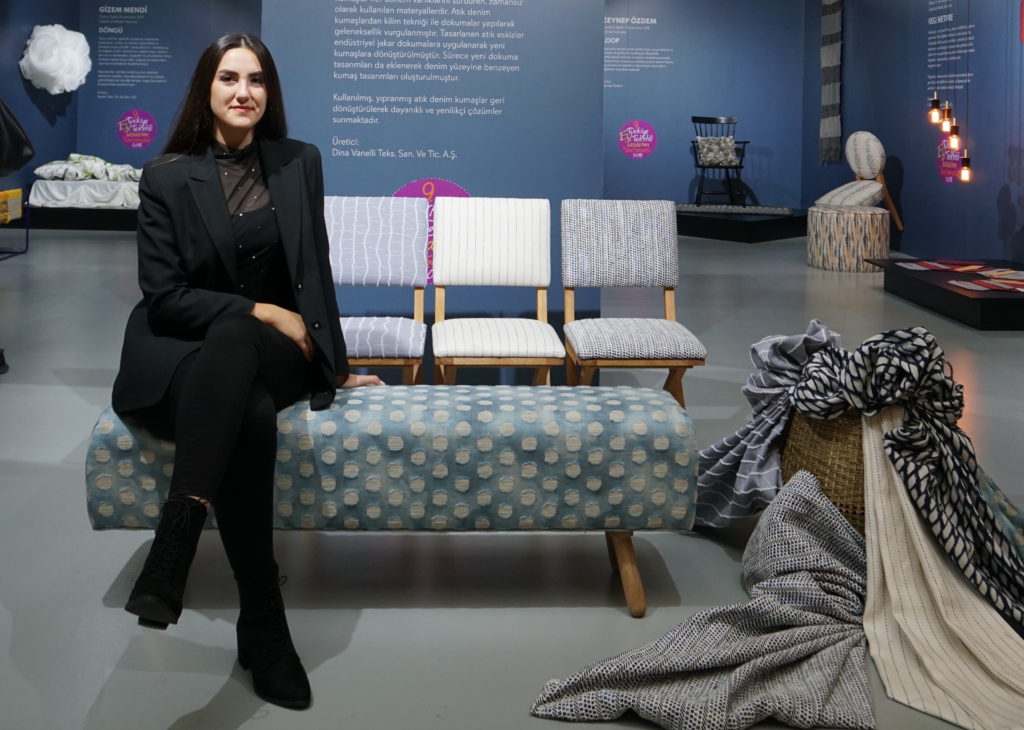
She participated in the competition with her project inspired by this topic and became one of the top 10 finalists. Afterward, a workshop accompanied by mentor Maarit Salolainen and moderator Elif Sezgin was held for these top 10 finalists in Bursa—one of the most important textile cities in Turkey. Finalists asked questions about sustainability and discussed the production processes of the projects during company visits to Dina Vanelli Textile, Güleser Textile, Polyteks A.Ş and İpeker Textile factories.
In addition to their projects, they wove the fabrics on looms during the workshop. The jury awarded first prize to Bengi’s design project after this development process. She also had the opportunity to work with Dina Vanelli Textile during the internship award of the competition. The fabric sketches selected for the competition were woven on industrial looms at the factory.
Carved in Blue: Can you please explain the project? Where does waste denim come from?
Dr. Özlenen: Nowadays, valorization of wastes is a general approach in all sectors. However, Bengi has used waste denim with a different point of view by combining art, design, aesthetic and technology in this project. Consequently, unique designs with different visual effects were created.
The “waste denim” theme of the project was selected in order to draw attention to consumption and sustainability by using denim wastes in surface designs. In the textile and fashion sector, excessive consumption due to fast fashion has led to negative environmental, economic and human impacts from pre-consumer and post-consumer waste.
First of all, attitudes and behaviors about consumption should change, and textile waste should be valorized. Researching new techniques and methods and then integrating them into production will make a significant contribution to this issue.
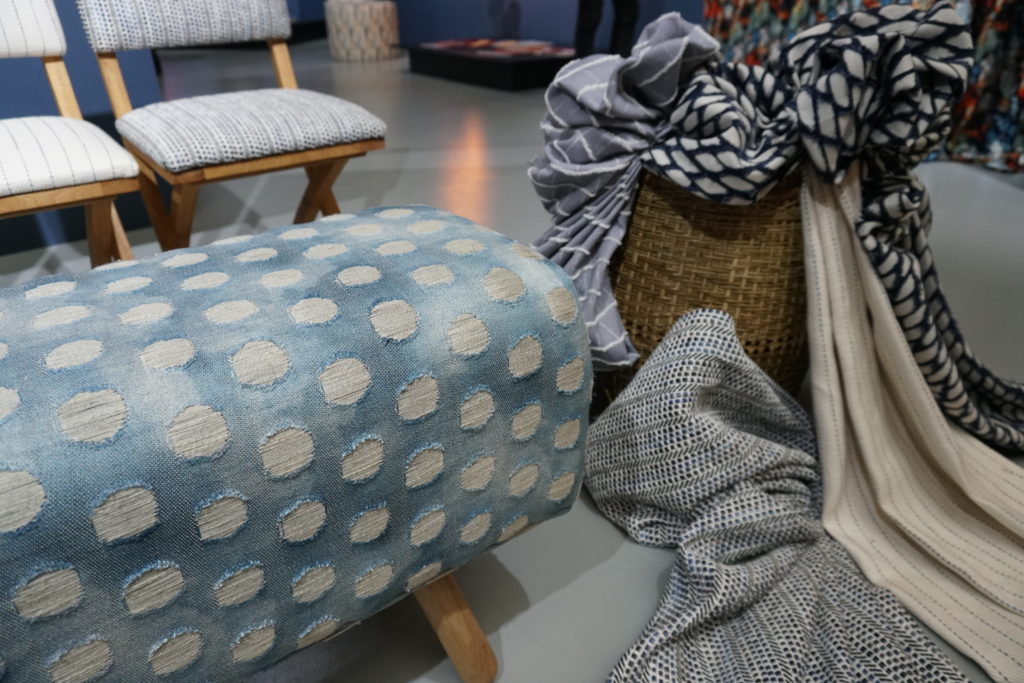
Sketches of denim fabrics were designed using waste from secondhand garments. In addition to the appearance and twill weave of the denim fabrics used, simple designs were produced with inspiration from nature and forms in nature. Sustainable traces of indigo blue were implemented in the designs.
Carved in Blue: What were the key learnings from this experience? What did you get the most out?
Bengi: I chose the topic of my master’s thesis with the guidance of Dr. Özlenen. We have realized the importance of sustainability and how much companies care about it nowadays through workshop and various factory visits. It was a good experience to see the implementation of denim in home textiles. Producing textile designs and high value added products with the theme of sustainability was great and extremely exciting.
Carved in Blue: Where do you want to make an impact in the textile industry? What change do you want to see in the industry?
Bengi: The concept of sustainability and interdisciplinary studies are essential approaches for all sectors of textile industry. I want to create unique designs by using environmentally friendly textile materials and combining art, aesthetic, science and technology. Use of time, cost and labor-saving technologies is vital for a sustainable life.
Innovative solutions can be found to save nature through new technologies. In the denim sector, ecological solutions such as use of laser to create visual effects have to be proposed. Thus, we can create very different designs in a sustainable way.
Carved in Blue: What is your dream job in textiles?
Bengi: Denim is an essential and very rich resource for me. As a textile designer, I intend to make environmentally friendly designs and to continue my design works on denim and other textile products. I also enjoy doing artistic and creative works and want to be an academician because I am keen on research, inspiration, learning and teaching new things.
Carved in Blue: What does Carved in Blue mean to you?
Bengi: As a denim-inspired designer, I follow Carved in Blue closely and believe it’s a very useful organization where all current information about denim is shared. As an environmentally friendly and sustainable fiber, use of Lyocell TENCELTM in denim has outstanding advantages in terms of sustainability and creating high-value denim products. I believe its use will continue to grow day by day.